Skills-Based Organization: how to implement a Competency-Based Organizational Model
Written by
Radical HR

Treating the Skills-Based Organization as just another management trend or as a superficial window-dressing project means ignoring the profound transformation taking place in the labor market.
For years, companies have been designed around a single principle: breaking the organization down into boxes, assigning a job description to each box, and searching the market for a person who matched that profile.
This setup assumed a stable context, where the skills required for a role remained identical for years. Today, when technology, automation, and business models change at a quarterly pace, expecting to channel corporate complexity into crystallized roles creates operational paralysis.
The transition to the skill-based model is not born out of a theoretical sensitivity, but from a need for organizational survival: allowing skills to flow where they are needed, at the moment they are needed.
And it is precisely by looking at the numbers that we realize how much the illusion of control guaranteed by the old organizational chart is already burning economic value.
The Illusion of the Organizational Chart: The Limitation of Job Descriptions
In 2012, Capron and Mitchell formalized the famous Build, Buy, Borrow paradigm: train internally, buy on the market, or borrow resources. For years this has been HR's compass and still is today in many organizations.
The company knows exactly who reports to whom and thus believes it is in control, when it is merely applying an obsolete model, born for a market that no longer exists.
Today this framework is outdated because it assumes that the raw material — skills — remains constant over time, without giving the organization any visibility into what people can actually do beyond their Job Title.
The findings of RADICAL HR's Future of Work Observatory confirm the fragility of this setup:
Accelerated obsolescence: the half-life of a technical skill has dropped to 3-5 years.
Transformation of work: by 2030, 39% of the skills currently demanded by the market will transform or become obsolete (World Economic Forum). A job description written three years ago describes a role that in fact no longer exists.
The hidden costs of turnover: the feeling of stagnation and the impossibility of moving internally push the best talent to seek growth outside. A company of 100 people with an average turnover of 10% burns about 200,000 euros every year in exit, recruitment, and loss of productivity costs.
It is at this point that skills-based management stops being a theoretical option and becomes a precise choice of corporate architecture.
What a Skills-Based Organization Really Is (and What It is NOT)
A Skills-Based Organization (SBO) is a business model in which work is broken down and assigned based on people's real skills (skills and capabilities), rather than being encapsulated in rigid Job Titles or role descriptions.
In a traditional structure, the reference equation has always been Job = Person + Duty. In a skills-based organization, the perspective is flipped into the post-industrial equation Person = Skills + Work.
This does not mean eliminating governance or erasing responsibilities, but moving from a rigid structure to a fluid network, where:
Projects and activities are assigned based on the suitable skills available at that moment, not based on the title written in the email signature.
Career paths stop being a vertical climb and become transversal growth trajectories (the so-called multiple careers).
The organization learns to manage an integrated workforce (Integrated Workforce), where hired employees, freelancers, and artificial intelligence tools collaborate around the same objectives.
There is a reassuring misunderstanding that has been circulating for some time: the idea that a Skills-Based Organization is something theoretical that came from Silicon Valley.
A nice narrative exercise for native digital companies, but completely inapplicable when it comes to making complex organizations with hundreds or thousands of people work.
This is a convenient belief because it protects the illusion that the traditional organizational chart and job descriptions written years ago continue to guarantee order and business control.
Reality demands a reality check: the forces driving work, from professional longevity to the impact of artificial intelligence, have already made flexible what was previously rigid. The choice is no longer whether to abandon the Role-Based model in favor of a fluid Skills-Based one, but how to manage this paradigm shift before being overwhelmed and left behind.
How to Transition from Roles to Skills: From Theory to Model
Mapping hundreds of skills on an Excel sheet is not an organizational transformation: it is just bureaucracy destined to become outdated in six months. To move from roles to skills without drowning in data requires an infrastructure engineered in clear, measurable, and replicable phases: the Skills-Flow Model.
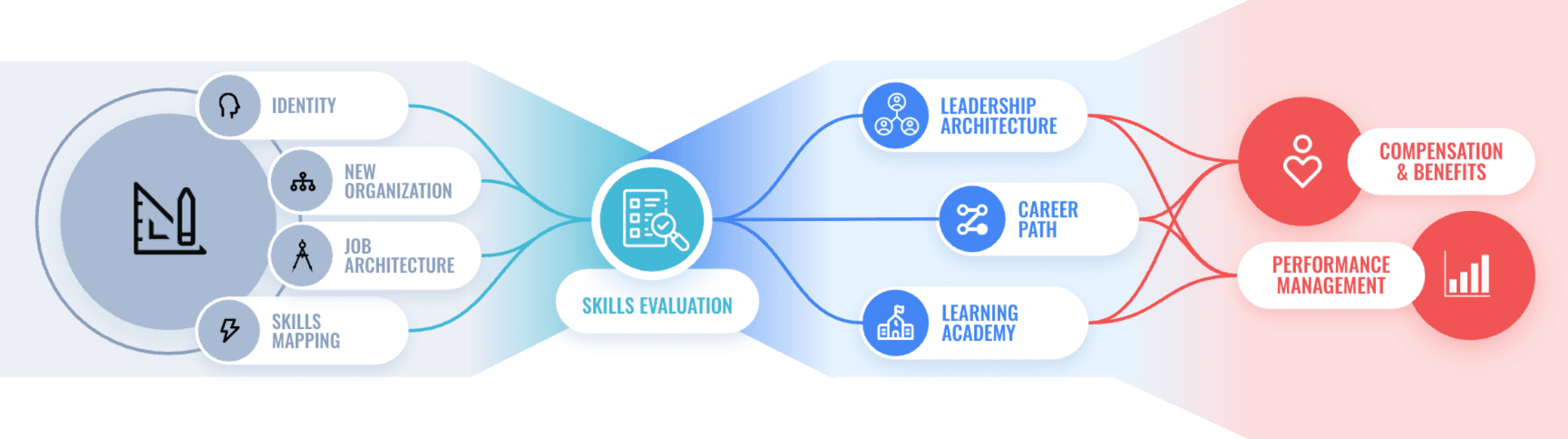
It is our reference framework that starts from the business direction to calculate the skills gap, trace growth trajectories, and activate a continuous cycle of development, engagement, and recognition through 4 macro-phases:
Blueprint (Setting the Rules of the Game): Eliminates gray areas and the classic "not my job". Defines the role architecture and the key skills the business needs to compete.
Snapshot (Assessment): captures the actual assets with reliable data. Through Skills Evaluation and Bridge Analysis, it measures the gap between the current state and the to-be.
Direction (Talent Activation & Mobility): making the pool of skills visible and tracked. Unlocks internal transversal mobility, transforming the management line into an enabler of skills.
Impact (Reward Policies & P&L Alignment): Connects salary growth and reward systems to versatility and certified skills (Skills-to-Pay Matrix), measuring the direct impact of skill density on the bottom line and corporate ROI.
Enable the transition in your organization:
The Skill-Based Transition in Production Plants: A Case Study
Moving from theory to practical application means dealing with the most complex operational environments, such as the network of Birra Peroni breweries.
Three industrial contexts with different historical layers and operational habits needed to overcome the rigidity of traditional duties, standardizing skills without halting the continuity of production lines.
The work was structured around three pillars:
Direct operational analysis: over 20 interviews and field observation sessions to map the real work, not the theoretical one of old manuals.
Co-design with the company population: involvement of more than 45 stakeholders including brewery directors, managers, and operators to build the new role architecture together with those who experience the plant every day.
Design of a new Job Architecture, defined by clear success profiles, shared across 26 key roles for development objectives.
The result is a scalable and standardized framework that allows the organization to manage operator versatility on objective grounds and plan recruitment and development decisions with extreme precision.

Radical HR
LinkedIn Profile