How AI Redefines Roles: Managing Skills Beyond the Org Chart
Written by
Radical HR
In summary:
The metamorphosis of value: according to our Future of Work Observatory, 40% of current skills will become obsolete by 2030, while the average lifespan of a technical skill stands at 3–5 years. However, the most disruptive impact affects behavioral aspects and coordination dynamics.
Widespread adoption, strategic vacuum: 61.2% of organizations in Italy already use Artificial Intelligence solutions, but 76.2% admit they lack a corporate roadmap to guide it (AI@Work study). The operational content of roles is dissolving, while the surface of the organizational chart remains unchanged.
The methodological response: without dynamic measurement of human capital through skills mapping, training, performance evaluations, and career paths continue to develop an infrastructure of roles that is now anachronistic.
The lever of internal mobility: management's territorial defense of individual silos blocks the circulation of capabilities, eliminating professional longevity and hindering the transition toward a skills-based organization.
In Italy, when Artificial Intelligence enters Executive Committee discussions, the Board almost always ends up asking the wrong question: how many headcounts need to be streamlined and in which business units.
It is the corporate version of a sterile public debate trapped in the dichotomy of "who replaces whom": on the one hand, a freeze on junior positions in hiring plans; on the other, resistance from senior profiles who watch a new graduate produce, in ten minutes and with the right generative tools, analyses that previously required years of consolidated experience.
This interpretation confuses the symptom with the cause. We are not facing a generational conflict, but rather the definitive loss of effectiveness of the traditional Job Description. For decades, the role title served as a reliable shortcut: each box corresponded to a rigid and predictable scope of skills. On this perfect alignment, we built career paths, development plans, compensation systems, and performance evaluation frameworks.
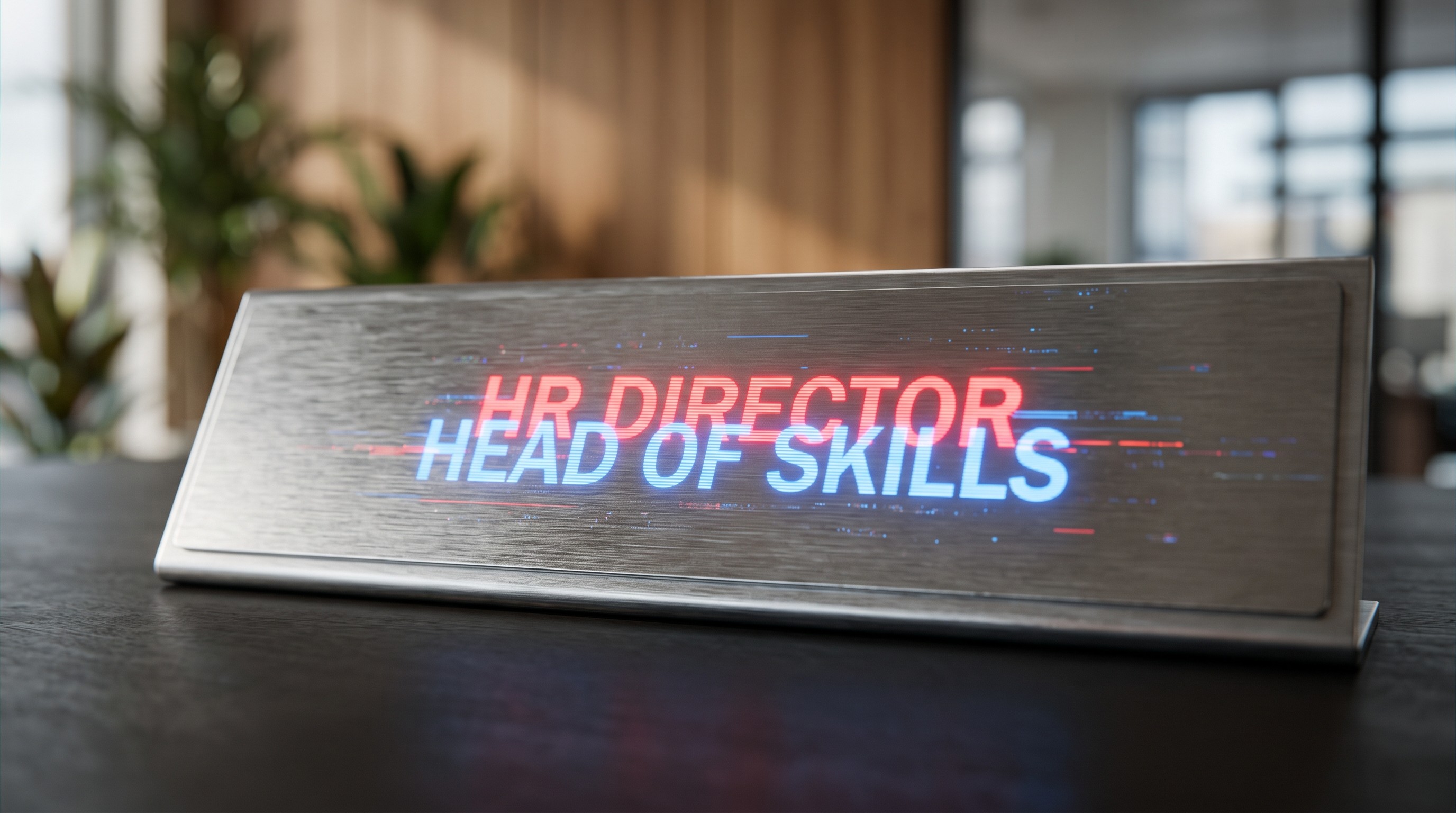
Today, AI does not eliminate formal roles: it hollows out and rewrites their operational substance from the inside, leaving the nameplate on the door intact. Managing this transformation requires, first and foremost, stopping looking at Job Titles and starting to measure the speed at which real skills are shifting across the organization.
The real evolution of skills in Italy: data from the Future of Work Observatory
Findings from our research highlight the structural fracture occurring across the country's business environments, exposing the contrast between the acceleration of technology cycles and the absence of organizational governance:
Contraction of the skills lifecycle: 40% of current skills will become obsolete by 2030; the average lifespan of a technical skill does not exceed 3–5 years (Future of Work Observatory).
Depreciation of managerial posture: the most critical obsolescence impacts the behavioral sphere, transforming coordination models, decision-making dynamics, and People Development processes long before digital skills alone.
Adoption without vision: although 61.2% of Italian organizations use AI tools, 76.2% operate without any strategic management roadmap (AI@Work study).
Automation of tactical tasks: 95% of companies launched AI experiments over the past year, but only one in five extracts tangible value from them; meanwhile, 22% of CHROs report that at least one business leader in their organization has stopped hiring for entry-level roles due to AI automation (Gartner survey of 110 CHROs).
Interpreted critically, these indicators show that the restructuring of work is happening from the bottom up, task by task, while the infrastructure used by HR departments to manage people remains anchored in static logic. The contraction of junior roles is merely the most visible manifestation of this disconnect, as low-complexity tasks absorbed by tools were concentrated there. The same erosion quietly runs through the entire corporate workforce: a coordination role consolidated over fifteen years now governs a completely new practical scope that no one has ever codified or redesigned.
It is the rift between real operations and their formal representation: the objective definition of skills mismatch.
Skills mapping against skills mismatch
As long as the correspondence between formal roles and real skills remained stable, role-based management ensured efficiency. Today, that overlap generates three major distortions in HR systems:
Inefficiency of training investment: L&D plans built on Job Descriptions develop a scope of activities that is dissolving, masking budget waste until business KPIs reveal performance inadequacies.
Incongruence of career paths: vertical promotions based on levels rather than capabilities grant formal titles that do not correspond to an actual increase in professional value.
Lack of visibility in Workforce Planning: cataloging the organization by boxes prevents management from knowing which capabilities are genuinely available and where untapped potential could create immediate impact.
Skills mapping steps in precisely at this breaking point: it replaces the formal label with content analysis, making available capabilities, those required by the business plan, and the resulting gap fully traceable. It is not a static, occasional audit, but continuous monitoring designed to update at the same pace at which skills depreciate.
The result is a principle valid for the entire corporate population: a professional's relevance does not lie in the box they occupy, but in the portability of their skills and the speed with which they acquire new ones. The position on the org chart is the most volatile element of the system; skills constitute the real asset: transferable, reconfigurable, and applicable across different projects and contexts.
This paradigm shift, however, produces highly asymmetrical impacts along the chain of command.
AI and Leadership: fostering Professional Longevity to manage internal mobility
For years, leading meant having the ready answer, process knowledge, and greater experience than the team. The moment complex analysis becomes accessible to anyone in seconds, the foundation of that power erodes: this is not a technological challenge, but a true crisis of leadership legitimacy.
The most common defensive reaction is retrenchment: managers fortify the boundaries of their function, hoard high-potential employees, and go back to measuring their importance by the number of resources they oversee. This is the behavioral trap that, in many large organizations, stalls talent reviews and slows down the strategic reallocation of teams to high-value projects.
It is a protectionist mindset that backfires on the organization. If the skills lifecycle has shrunk to 3–5 years, the only way to preserve human capital value is to keep skills circulating: moving people across functions, exposing them to challenging environments, and making widespread capabilities visible. Internal mobility is the lever that turns skills mapping into dynamic value; hindering it means accelerating the turnover of top talent.
At the same time, fluid circulation is the prerequisite for professional longevity: in a career trajectory destined to exceed thirty years, ensuring people's relevance means guiding them through different roles and domains multiple times over their careers. For leaders, this shift requires a profound change in posture: legitimacy no longer comes from "knowing more," but from the ability to interpret complex contexts, unlock the team's potential, and act as a growth accelerator toward other areas of the business. An evolution that begins, first and foremost, with the ability to unlearn old models of control.
And it is precisely this ability to unlearn that powers organizational learning.
Learning Agility and reskilling: the transition to a Skills-Based Organization
If corporate value is measured by the speed of learning, learning agility becomes the primary capability that HR departments must be able to track, evaluate, and develop. Consequently, reskilling stops being an emergency measure and transforms into an integrated systemic process, calibrated to the three-to-five-year obsolescence cycle of skills.
For this dynamic to unlock its full potential, a new management architecture is required: the transition to a Skills-Based Organization. A model built on roles designed around real tasks, continuous skills tracking, project allocation driven by actual capabilities rather than hierarchical status, and reward systems tied to the expansion of professional competencies.
This is the conceptual foundation of our Skills-Flow Model, designed to reshape the three operational decisions that People Management faces weekly: project resource allocation, the distribution of training investments, and metrics recognizing professional growth. Three decision levers that can no longer rely on the formal role title.
FAQ: how to manage AI within the organizational chart
How is the content of roles changing with artificial intelligence?
AI progressively absorbs and automates lower-complexity tasks that make up daily operations, while leaving the Job Title unchanged. This creates a disparity: the actual content of work transforms from within, while career paths, development tracks, and evaluation metrics remain calibrated to a role that no longer reflects actual activity.
What is skills mismatch and how is it measured?
It is the structural gap between the skills actually present across the corporate workforce and those required to execute the business plan. It is measured through rigorous skills mapping processes: auditing existing capabilities, comparing them with corporate targets, and quantifying the gap. Since our findings indicate that 40% of current skills will be obsolete by 2030, this monitoring must be carried out continuously.
Why is internal mobility critical for professional longevity?
Over extended career paths, remaining relevant in the market requires cyclically refreshing one's skill set—a dynamic that occurs primarily through exposure to varied contexts (functional shifts, participation in task forces, project-based mobility). When managers hoard people to safeguard their own boundaries, they halt this circulation and accelerate the depreciation of human capital.
Where do you begin when transitioning to a skills-based organization?
The starting point is not redesigning the organizational chart, but objectively assessing real skills and measuring the distance from strategic business priorities. This is the transformation initiated across the three Birra Peroni production plants: read the full case study. Only afterward do you redesign the role architecture, enable fluid internal mobility policies, and tie development and total reward systems to the actual growth of skills.

Radical HR