Corporate Wellbeing 2025
The gap between intentions and reality: only 3 out of 10 leaders truly believe in corporate well-being.
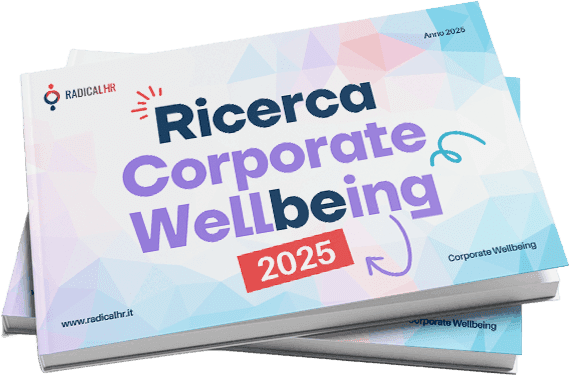
The third edition of the "Corporate Wellbeing" research by the Future of Work Observatory of RADICAL HR analyzes the level of maturity of holistic wellbeing in Italian companies and offers a strategic roadmap to bridge the gap between perception and reality.
download the paper

How we did the research
To move from opinions to facts and provide solid data, we analyzed the state of Wellbeing in Italy through a quantitative survey that involved:
Over 250 professionals from as many companies.
A sample spread across 16 Italian regions.
A targeted audience: the sample is mainly composed of figures who have a real pulse on wellbeing in organizations (41% HR Manager, 19% HR Director, 16% HR Specialist).
What you'll find inside
The research "Corporate Wellbeing 2025" does not merely capture the existing situation, but charts the course.
The report analyzes the state of Wellbeing in Italy through 5 key dimensions and delves into crucial vertical trends, such as support for caregivers, through the case studies "Sharing is Caring" carried out in partnership with UGO.
download the paper
Key data for the 5 dimensions in Italy
Career Wellbeing
Personal satisfaction
Present in 44% of companies. 4 out of 10 companies offer career paths, development plans, or mentorship. Training (87%) is by far the most frequent initiative.
Social Wellbeing
Relationship quality
46% of companies have active projects. Onboarding confirms itself as the main activity (68%) for creating connections.
Financial Wellbeing
Financial well-being
It is the laggard: the least developed dimension of well-being (32%). In 3 out of 10 companies, no initiatives are dedicated to it.
Physical & Mental Wellbeing
Mental health
A priority in 1 out of 2 companies (51%). Training is the most common initiative (42%), but in 18% of companies there is still no specific initiative.
Environmental Wellbeing
Work Environment
It is the area in which companies invest the most (65%). The approach is “digital-first”: the most widespread initiative is software training (53%).